
In the first part of this series, I wanted to test the claim that dollar cost averaging (DCA) was an effective strategy for protecting your investments. Too often I’ve heard claims against investing within the media saying that if you had bought stocks (particularly) during “The Lost Decade” between 2000 and 2010, then you would have had a -23% return on your money. After crunching the numbers, we determined that dollar cost averaging would have beat a static investment in the S&P 500 and returned a -6.8% return instead of a -23%. That’s great, but who wants a negative return?! Why didn’t we just hide our money under the mattress and do nothing? Unfortunately, that may be true. But remember that when it comes to investing: Defense … [Read more...] about Would Dollar Cost Averaging and Bonds Have Saved You From “The Lost Decade”?
Stocks & Investing
Would Dollar Cost Averaging Have Saved You From “The Lost Decade”?
From time to time when I get my 401k statement, there is a small newsletter mixed in with my financial statement. It usually presents some very introductory information about retirement, investments, etc. In this issue one of the topics was dollar-cost averaging. For those of you who don’t know, dollar cost averaging (DCA) is a strategy where you invest the same amount time after time. During the good times when shares are higher, you buy fewer shares. During the rough times when shares are lower, you buy more shares. This strategy prevents you from buying at the wrong time and over-spending or under-spending on your investments by “averaging” your price over time among these periodic investments. Sound familiar? That’s exactly what … [Read more...] about Would Dollar Cost Averaging Have Saved You From “The Lost Decade”?
Is It Time to Change Up My Retirement Portfolio?

If you believe at all in the January Barometer (financial-folk-lore that if markets do well in January, the year will be good), then we’re in for a great year! The S&P 500 is up approximately 8% this year and most of the economic reports seem to be more upbeat than they have been in recent years. So what is there to worry about? Well, in the words of Warren Buffett: • “Be fearful when others are greedy, and be greedy when others are fearful”. Looking for Safety: When my 401k dropped nearly 50% during the Great Recession, I decided it was time to stop playing offense and beef up my defense when it came to how I invest my money. … [Read more...] about Is It Time to Change Up My Retirement Portfolio?
Book Review: “Higher Returns from Safe Investments” by Marvin Appel
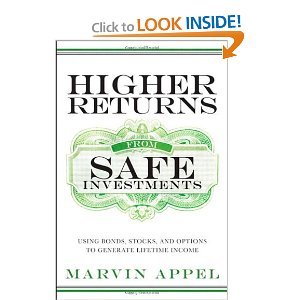
This isn’t another book of “buy a bunch of stocks, hold them for 30 years, and hope for the best” type of investment advice. “Higher Returns from Safe Investments: Using Bonds, Stocks, and Options to Generate Lifetime Income” by Marvin Appel delivers an alternative perspective on the risks and returns from other types of investments; namely bonds. However, he doesn’t just stop there. The book also covers a broad range of other under-appreciated investments such as high-dividend stocks, preferred stocks, and covered call options. I’ll be the first to admit: There is nothing sexy about reading a book about bonds. But after experiencing the evaporation of money during the Great Recession of 2008, I think a book with this sort of title … [Read more...] about Book Review: “Higher Returns from Safe Investments” by Marvin Appel
Trying Out “The Big Secret” Stock Picking Strategy

Just admit it. You do it. I do it too. I’m talking about reading a book with reasonable advice and then never acting on any of it. Not even for a test run. It’s not that we’re lazy or not smart enough to carry it through. It’s just that for some reason it’s really hard to make that leap of faith and act on what we know we should be doing. Well, there’s always a time to start. This summer, I read the book “The Big Secret for the Small Investor” by Joel Greenblatt because I was interested in stepping up my stock picking game. If you’d like to read my book review, click here. In Part “A” of Greenblatt’s “Big Secret” plan, he concludes that: … [Read more...] about Trying Out “The Big Secret” Stock Picking Strategy
Book Review: “The Little Book of Big Dividends” by Charles B. Carlson
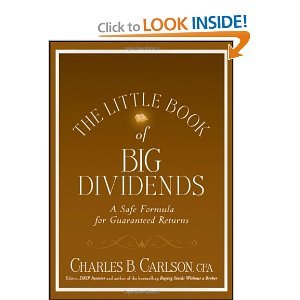
If you think that putting your money into bonds or CD’s is the only way to hedge against the roller-coaster ride of the stock market, think again! Author Charles Carlson demonstrates that an age old benefit of owning stocks called “dividends” can be used to create a stream of income and protect against market conditions. Right now if you asking yourself “what is a dividend?”, then this is the right book for you. “The Little Book of Big Dividends” is a great introduction for anyone looking to get acquainted with dividends and how they relate to stocks. The material is easy to read and it is not overly equation-heavy (except for the Appendix) or preachy on risky investments. In fact, Carlson’s advice is very modest and follows the lines of … [Read more...] about Book Review: “The Little Book of Big Dividends” by Charles B. Carlson
Book Review: “The Big Secret for the Small Investor” by Joel Greenblatt
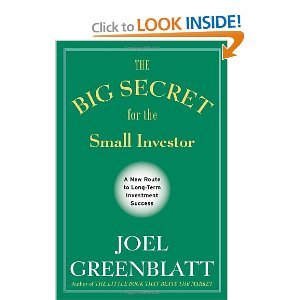
Click the image to visit Amazon.comPersonality. Sarcasm. Normally I don’t use entertaining words to describe personal finance books, but this one embodies those qualities. In this very brief read by Joel Greenblatt (an investment company owner and professor at the Columbia Business School), Greenblatt colorfully lays out his arguments and foundation for his two part (A and B) investment plan which he refers to as his “Big Secret”. … [Read more...] about Book Review: “The Big Secret for the Small Investor” by Joel Greenblatt